26 Oct 2010 | Index Index, minipost
A political blogger was arrested on Monday. Phan Thanh Hai, who blogs as Saigon Brother Three, was taken from his home in Ho Chi Minh after a police raid. His wife says that he has been detained for the “publication of false information”. Another blogger, Nguyen Van Hai, who had reached the end of his two and a half year prison sentence for tax evasion, has been hit with new charges. He is now accused of campaigning against the one-party communist state.
22 Oct 2010 | Azerbaijan News, Index Reports, News
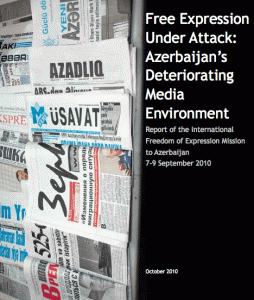 Observers including Index on Censorship’s Natasha Schmidt report on the country’s climate of fear
Ahead of Azerbaijan’s upcoming parliamentary elections, nine organisations, including Index on Censorship, are launching a new report titled Free Expression under Attack: Azerbaijan’s Deteriorating Media Environment. The report findings come out of a joint freedom of expression mission to the country in September 2010 and highlight the Azerbaijani government’s failure to comply with its international commitments to promote and protect freedom of expression. (more…)
19 Oct 2010 | Index Index, minipost
A Canadian court has placed numerous restrictions on an activist as part of his bail release. Alex Hundert may not speak with any member of the press, nor may he plan, attend, or participate in any public event related to a political issue. He was charged with three counts of conspiracy for involvement in violent activities at the G20 summit in Toronto last June. Hundert was released in July on $100,000 bail with around 20 court-imposed restrictions, including a ban on attending public demonstrations. After being rearrested for participating in a panel discussion at Ryerson University, he was released on 13 October on the condition that he adhere to additional restrictions. The Canadian Civil Liberties Association has said the measures are “only aimed at silencing speech“.
6 Oct 2010 | Uncategorized
The reporting of suicides is a very tricky business for journalists. On the one hand, any inquiry made of a bereaved family, or indeed any reporting at all in some cases, risks being criticised as intrusive and heartless, and on the other hand there is great concern about revealing methods.
It is hardly surprising that reporters and editors often back off the subject altogether, and that most suicides go unreported. But there are dangers in silence too.
The question is current after the Samaritans suggested that coverage of a recent double suicide in west London may have prompted a second double suicide 10 days later in Essex. At the same time the Press Complaints Commission (PCC) has rejected a complaint against the Southern Daily Echo about its reporting of method in a suicide case.
I can’t imagine any sensible or responsible journalist questioning the importance of getting this sort of thing right: nobody wants more suicides and certainly nobody wants to write or publish anything that might cause a death.
Nor could anyone reasonably challenge the need for the Samaritans and others to remind journalists forcefully of the need for care, especially in the light of a MediaWise Trust study (pdf) which found plenty of reporters not properly familiar with the guidelines.
And as for intrusion and insensitivity, the coverage of the Bridgend suicides in 2007-8 left no doubt that the press is capable of shameful conduct in the midst of terrible tragedy.
But there is a risk to the public interest here that is rarely discussed. What if it becomes the norm not to cover suicides?
What if, for fear of upsetting families who are also readers and viewers, and for fear of publicising methods, the local and regional news media simply decide that, barring exceptional circumstances, they will ignore suicides?
This is not fanciful: the MediaWise study contains strong hints of such an attitude among journalists, and previous research found it too. In places where there is a bridge where suicides occur, for example, the local paper will sometimes never mention those deaths, individually or collectively, as a matter of policy.
A media suicide taboo of a more general kind would presumably have benefits. It would mean an end to intrusion in such cases and it would remove the risk that reporting might encourage copycat suicides.
But it would also leave the public, already poorly informed about suicide, knowing considerably less. Do we want that? Do we want people thinking that suicide is rarer than it is, because they never see a case reported?
For me this has less to do with the methods issue (although, as the PCC recognises, that is ethically quite complex) than with some peculiar modern perceptions of privacy.
In response to the Bridgend reporting horrors and in the recent debates about altering inquest rules the argument was sometimes made that suicide was a private matter and that the news media had no business reporting it. This can not be true.
Death, like birth and marriage, is formally and legally a matter of public record, and it could not be otherwise. Try imagining a world in which it was possible for someone to die, and for their relatives, carers or employers to declare that the circumstances were nobody else’s business.
We also know from long experience that it is not satisfactory to leave important matters to officialdom, to be sorted out behind closed doors. Like it or not, the news media have a responsibility to ensure that deaths which seem out of the ordinary — such as suicides — are properly and openly discussed, and not hidden away.
Yes, this public treatment may cause distress, but it is necessary in a properly ordered, democratic society. How the press go about the task is certainly a matter for discussion, but whether they have the right to do it should not be.
Brian Cathcart is professor of journalism at Kingston University London
