27 Apr 2017 | Digital Freedom, News, Turkey Uncensored, Volume 46.01 Spring 2017
[vc_row][vc_column][vc_column_text]
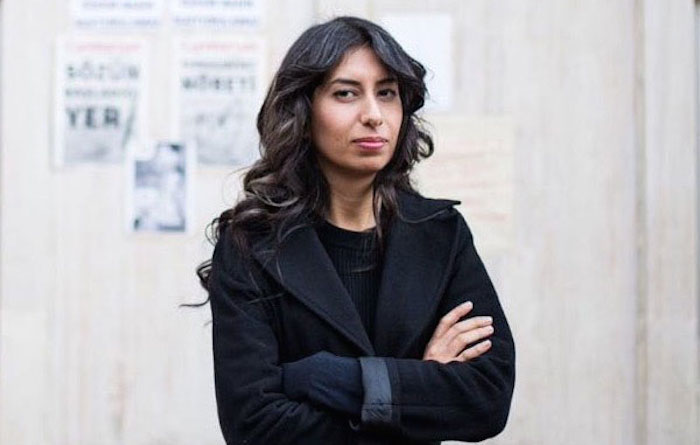
Cumhuriyet reporter Canan Coşkun
Credit: Antonin Weber
[/vc_column_text][/vc_column][/vc_row][vc_row][vc_column][vc_custom_heading text=”Canan Coşkun, a journalist at daily newspaper Cumhuriyet who faces two upcoming trials for her reporting, talks about her attitude to the dangers of life as a reporter in Turkey, in the Spring 2017 issue of Index on Censorship magazine” google_fonts=”font_family:Libre%20Baskerville%3Aregular%2Citalic%2C700|font_style:400%20italic%3A400%3Aitalic”][/vc_column][/vc_row][vc_row][vc_column][vc_column_text]
Every two to three weeks recently, I have seen off a colleague leaving the courthouse for prison or snatched a few moments with a deeply missed, and now detained, workmate in the shadow of the authorities. But we aren’t afraid of this dungeon darkness because we journalists are only doing our jobs.
I have been a court reporter for Cumhuriyet since 2013, so I spend the large majority of my working life in the courts. We all have moments we cannot forget from our working lives. For me, one such day was 5 November 2016, the day when 10 of our writers and managers were arrested. I was waiting for the court’s decision right behind the barrier in the court building, and the moment I heard the decision I felt a flush of pride for our 10 writers and managers, followed by anger and deep depression for my friends.
I felt proud because the fact that they had been arrested for their journalism had been mentioned in the court’s decision. In listing examples of our reporting as the reason for the arrests, the judge took the government’s insistence that “they were not arrested for their journalism” and threw it out of the window. I felt anger and sadness because we were sending our friends off to an indefinite spell of captivity. The police would not even allow us to say goodbye to our colleagues who were only 30 or 40 metres away behind a barrier. But among the many feelings I had, fear was not one of them. When the attacks on journalism are on this scale, fear becomes a luxury.
After our 10 colleagues were arrested, many journalists from around Europe began visiting our newspaper’s offices. Our foreign counterparts wanted to hear about what had happened and how we felt, and they all had the same question: “Are you afraid?” From November onwards, arrests of journalists have continued at a regular pace. But just as on that day, my answer to that question today is short and sweet: “No!”
We are not afraid, because we are doing our work and we are concerned only with our work. We are not afraid, because we too feel as if we have been in Silivri prison with our colleagues for these long months. We are not afraid, because very little difference remains between being in and out of prison. We are not afraid, because the heads of our jailed colleagues are held high. We are not afraid, because Fethullah Gülen, the exiled cleric accused by the government of being behind last year’s failed coup attempt, was not once our “partner in crime”. We are not afraid, because the Cumhuriyet that governments of every era have tried to silence has only reported, is only reporting and will only report.
[/vc_column_text][/vc_column][/vc_row][vc_row][vc_column width=”1/4″][vc_icon icon_fontawesome=”fa fa-quote-left” color=”custom” align=”right” custom_color=”#dd3333″][/vc_column][vc_column width=”3/4″][vc_custom_heading text=”When the attacks on journalism are on this scale, fear becomes a luxury” google_fonts=”font_family:Libre%20Baskerville%3Aregular%2Citalic%2C700|font_style:400%20italic%3A400%3Aitalic”][/vc_column][/vc_row][vc_row][vc_column][vc_column_text]
Ahmet Şık, a reporter at my newspaper, has been under formal arrest since December 2016. Back in 2011, along with former military chief of staff İlker Başbuğ and many soldiers, police, journalists and academics, he spent more than a year in prison in relation to the “Ergenekon” case. The accusation was that they were attempting to overthrow the government.
Şık is currently under arrest accused of conspiring with the Gülen movement. But Turkey’s justice system is such that the case in which Şık was arrested in 2011 still continues, and this gave us a chance to see him in court on 15 February. I waited outside the courtroom doors and when they opened all I saw inside was a face smiling with hope: he was able to see his friends for the first time in months. Although Şık is a much more experienced journalist than I am, his desk in the office was close to mine and I missed him.
At that hearing, he summarised today’s fight to carry out journalism under the state of emergency, saying: “The story of those who think they have power, and who use this power to persecute journalists is as long as journalism itself.”
Last December, six journalists, including some of my friends, were held for 24 days in an inquiry into the hacking of minister Berat Albayrak’s emails. (Albayrak is President Recep Tayyip Erdogan’s son-in-law.) Three of these journalists were later formally arrested by the courts. During this time, detained journalist Mahir Kanaat became a father, but he was unable to see his child. Fellow detainee Tunca Öğreten was not given the right to send and receive letters, or see anyone except his close relatives. He had to propose to his girlfriend via his lawyers.
Recently, I listened to one of these journalists relate a memory from his time in court. Having had their faith in justice shaken, they instead turned to superstition in the courtroom in a bid to be set free. Metin Yoksu, a freed journalist, said three of them had sat close to the courtroom exit and had replaced their shoelaces – which had been taken from them – with laces they had made from bits of water bottles. The result: those who were freed were those who had sat near the exit door.
Trust in Turkey’s justice system has fallen so far that we now rely on our superstitions. How depressing.
[/vc_column_text][/vc_column][/vc_row][vc_row][vc_column][vc_column_text]
This article is part of the spring 2017 issue of Index on Censorship magazine. You can read about all of the other content in the magazine here.
Journalist Canan Coşkun is a court reporter at Cumhuriyet. She is currently charged with defaming Turkishness, the Republic of Turkey and the state’s bodies and institutions in one of her articles. Her article covered the story of a truck full of weapons hidden under onions. The second charge is that she depicted the police who combat terrorism as a target, for a story about Turkish Kurds being arrested.
Turkey Uncensored is an Index on Censorship project to publish a series of articles from censored Turkish writers, artists and translators.
Translated by John Butler
[/vc_column_text][/vc_column][/vc_row][vc_row][vc_column][vc_custom_heading text=”From the Archives”][vc_row_inner][vc_column_inner width=”1/3″][vc_single_image image=”80569″ img_size=”213×289″ alignment=”center” onclick=”custom_link” link=”http://journals.sagepub.com/doi/pdf/10.1177/0306422016657010″][vc_custom_heading text=”We are journalists, not terrorists” font_container=”tag:p|font_size:24|text_align:left” link=”url:http%3A%2F%2Fjournals.sagepub.com%2Fdoi%2Fpdf%2F10.1177%2F0306422016657010|||”][vc_column_text]June 2016
Valeria Costa-Kostritsky looks at a developing trend where journalists are being accused of terrorism and arrested for reporting the news.[/vc_column_text][/vc_column_inner][vc_column_inner width=”1/3″][vc_single_image image=”89086″ img_size=”213×289″ alignment=”center” onclick=”custom_link” link=”http://journals.sagepub.com/doi/pdf/10.1177/0306422013489932″][vc_custom_heading text=”Turkey’s media: a polluted landscape
” font_container=”tag:p|font_size:24|text_align:left” link=”url:http%3A%2F%2Fjournals.sagepub.com%2Fdoi%2Fpdf%2F10.1177%2F0306422013489932|||”][vc_column_text]July 2013
As protests continue in Istanbul, journalist Yavuz Baydar calls for the media to resist government pressure to filter the news.[/vc_column_text][/vc_column_inner][vc_column_inner width=”1/3″][vc_single_image image=”80569″ img_size=”213×289″ alignment=”center” onclick=”custom_link” link=”http://journals.sagepub.com/doi/pdf/10.1177/0306422016657030″][vc_custom_heading text=”Scoops and troops: Turkey’s future ” font_container=”tag:p|font_size:24|text_align:left” link=”url:http%3A%2F%2Fjournals.sagepub.com%2Fdoi%2Fpdf%2F10.1177%2F0306422016657030|||”][vc_column_text]June 2016
Writers from acclaimed independent newspaper Radikal on its closure and the shape of Turkish investigative journalism today.[/vc_column_text][/vc_column_inner][/vc_row_inner][vc_separator][/vc_column][/vc_row][vc_row][vc_column width=”1/3″][vc_custom_heading text=”The Big Squeeze” font_container=”tag:p|font_size:24|text_align:left” link=”url:https%3A%2F%2Fwww.indexoncensorship.org%2Fmagazine|||”][vc_column_text]The spring 2017 issue of Index on Censorship magazine looks at multi-directional squeezes on freedom of speech around the world.
Also in the issue: newly translated fiction from Karim Miské, columns from Spitting Image creator Roger Law and former UK attorney general Dominic Grieve, and a special focus on Poland.[/vc_column_text][/vc_column][vc_column width=”1/3″][vc_single_image image=”88788″ img_size=”medium” alignment=”center” onclick=”custom_link” link=”https://www.indexoncensorship.org/magazine”][/vc_column][vc_column width=”1/3″][vc_custom_heading text=”Subscribe” font_container=”tag:p|font_size:24|text_align:left” link=”url:https%3A%2F%2Fwww.indexoncensorship.org%2Fsubscribe%2F|||”][vc_column_text]In print, online. In your mailbox, on your iPad.
Subscription options from £18 or just £1.49 in the App Store for a digital issue.
Every subscriber helps support Index on Censorship’s projects around the world.
 SUBSCRIBE NOW[/vc_column_text][/vc_column][/vc_row]
27 Apr 2017 | Mapping Media Freedom, News, Turkey, Turkey Uncensored
[vc_row][vc_column][vc_column_text]
What is usually the first pledge made by a politician who has won an election in his victory speech?
Erdogan’s was the death penalty.
Before the result of the 16 April referendum, which ended neck and neck, was even clear he came out onto the balcony and gave the “good news” to his supporters shouting “we want the death penalty!” that they would soon get their wish.
By abolishing the death penalty at the start of the 2000s, Turkey overcame an important obstacle in its negotiations with Europe. Now Erdogan is planning to bring back the death penalty, bombarding relations with Europe which are already at breaking point. And it was not just this. Two days after the referendum the government took the decision to extend the State of Emergency by three months. The extension of this emergency regime, which has been in force since 15 July 2016, was a concrete response to those expecting Erdogan to loosen the reins after the referendum. Sadly, Turkey now awaits not a time of relative peace, but a much more intense and chaotic period of repression.
There are a few different reasons for this.
The first is that it has become understood that Erdogan actually lost the referendum… Had the Supreme Electoral Board not taken the decision to count invalid votes as valid before the voting had even ended, Erdogan would not now be an executive president: he would be a leader who had lost a referendum. Since that day, hundreds of thousands of people have protested in the streets, shouting that their votes had been stolen. These protests have frightened the government, afraid they might turn into the Gezi uprisings of four years before. This is one reason for the increase in repression…
Another reason is that Erdogan has lost the big cities for the first time… The AKP, which has held onto key cities such as Istanbul and Ankara throughout its 15 years of power, has been beaten in these cities for the first time in this referendum. If we consider that Istanbul is the city in which Erdogan began his political career, it’s possible to say that his fall has also begun there. This is something that Erdogan will be losing sleep over…
Add to this disgruntlement an economy in the doldrums, especially with the wiping out of tourism revenues, and the withdrawal of the support from European capitals that had been given in pursuit of a refugee agreement, and you can understand why Erdogan is under so much pressure.
Now his only support comes from the Trump regime, which needs their help in Syria, from international capital which prefers authoritarian power to democratic chaos and from the social democratic opposition, still searching for a solution through a legal system that has long ago passed into Erdogan’s hands…
Can Erdogan balance out his shunning by Europe with the relationships he is striving to build with Trump and Putin?
By being part of the Syrian war, can he undo the tensions that are mounting at home?
Can he rein in the growing Kurdish problem by keeping jailed the co-presidents and around 10 MPs belonging to the HDP, the political representatives of the Kurds?
Can he hide the repression, lawlessness, and theft by jailing 150 journalists, silencing hundreds of media organs, throwing the foreign press out of the country and even punishing those who tweet?
I don’t think so.
All the data points to this last referendum being the beginning of the end for Erdogan. He will not go quietly, because he can guess what will happen to him if he loses power. But from here on in, he will pay a heavy price for every repressive act.
Just before the referendum, Theresa May visited Turkey and, turning a blind eye to the human rights violations, signed a contract for the construction of warplanes. Things in Ankara may have changed a great deal by the time those planes are ready.
Maybe in London too…
Yet those in Turkey fighting at the cost of their lives for democracy, a free media, and gender equality will never forget that the leader of a country accepted as “the cradle of these principles” did not even once mention them when she arrived in Ankara to trade arms.
Erdoğan için sonun başlangıcı
Seçim kazanmış bir siyasetçinin zafer konuşmasında ilk vaadi ne olabilir?
Erdoğan’ınki idam cezası oldu.
16 Nisan’da yapılan ve neredeyse başabaş sona eren referandumun kesin sonuçları açıklanmadan, sarayının balkonuna çıktı ve “İdam isteriz” diye bağıran taraftarlarına, istediklerine çok yakında kavuşacakları “müjdesini” verdi.
Türkiye, idam cezasını 2000’lerin başında kaldırarak, Avrupa ile müzakerelerin önündeki önemli bir engeli aşmıştı. Şimdi Erdoğan, idam cezasını yeniden getirerek Avrupa ile zaten kopma noktasındaki ilişkileri bombalamaya hazırlanıyor.
Sadece o da değil, referandumdan iki gün sonra Hükümet, Olağanüstü Hal’i üç ay daha uzatma kararı aldı. 15 Temmuz darbe girişiminden beri uygulanan sıkıyönetim rejiminin uzatılması, referandumdan sonra Erdoğan’ın ipleri gevşeteceğini bekleyenlere somut bir cevap oldu.
Ne yazık ki, Türkiye’yi huzur değil, çok daha ağır ve kaotik bir baskı dönemi bekliyor.
Bunun birkaç nedeni var:
Birincisi, referandumu Erdoğan’ın aslında kaybettiğinin anlaşılması… Henüz sandıklar kapanmadan, Yüksek Seçim Kurulu’nun aldığı bir kararla, geçersiz oylar geçerli sayılmasa, Erdoğan şu an Başkan değil, referandum kaybetmiş bir liderdi. O günden beri, yüzbinlerce insan caddelerde oylarının çalındığını haykırarak protesto gösterisi yapıyor. Bu protestoların, 4 yıl önceki Gezi ayaklanmasına dönüşmesi, iktidarı korkutuyor. Baskının artırılmasının bir nedeni bu…
Bir başka neden, Erdoğan’ın ilk kez büyük kentleri kaybetmiş olması… 15 yıllık iktidarı boyunca İstanbul, Ankara gibi kilit kentleri elinde tutan AKP, ilk kez bu referandumda bu şehirlerde yenildi. İstanbul’un, Erdoğan’ın siyasi kariyerine başladığı kent olduğu düşünüldüğünde, düşüşünün de oradan başladığını söylemek mümkün. Bu da, Erdoğan’ın uykularını kaçıran bir unsur…
Bu huzursuzluğa bir de özellikle turizm gelirlerinin sıfırlanmasıyla düşüşe geçen ekonomiyi ve Avrupa başkentlerinin mülteci anlaşması uğruna verdikleri desteği çekmesini ekleyin; Erdoğan’ın neden bu kadar sıkıştığını anlarsınız.
Şimdi tek dayanağı, Suriye’de kendisine ihtiyaç duyan Trump rejimi, demokratik bir kaos yerine otoriter bir istikrarı tercih eden uluslararası sermaye ve çareyi çoktan Erdoğan’ın eline geçmiş yargı sisteminde arayan sosyal demokrat muhalefet …
Erdoğan, Avrupa’dan dışlanışını, Trump ya da Putin’le kurmaya çabaladığı ilişkiyle dengeleyebilir mi?
Suriye savaşına dahil olarak, içerde yaşadığı gerilemeyi tersine çevirebilir mi?
Kürtlerin siyasi temsilcisi olan HDP’nin eşbaşkanlarını ve 10’u aşkın milletvekilini hapiste tutarak tırmanan Kürt sorununu dizginleyebilir mi?
150 gazeteciyi hapsedip, yüzlerce medya organını susturarak, yabancı basını ülkeden kovup tweet atanları bile cezalandırarak, yaşanan baskıları, hukuksuzlukları, hırsızlıkları saklayabilir mi?
Bence hayır.
Bütün veriler, son referandumun Erdoğan için sonun başlangıcı olduğunu ortaya koyuyor. Düşerse başına gelecekleri tahmin ettiği için kolay çekilmeyecektir. Ancak bundan sonra her yapacağı baskı için ağır bedel ödeyecektir.
Başbakan Theresa May’in tam referandum öncesi yaptığı Türkiye ziyaretinde, insan hakları ihlallerini görmezden gelerek yapımına imza attığı savaş uçakları hazır olduğunda, Ankara’da işler hayli değişmiş olabilir.
Belki Londra’da da…
Yine de demokrasi için, özgür medya için, laiklik için, kadın-erkek eşitliği için canı pahasına mücadele veren Türkiyeliler, “bu ilkelerin beşiği” kabul edilen ülkenin liderinin silah ticareti için geldiği Ankara’da, bu ilkeleri ağzına bile almamasını asla unutmayacaktır.
[/vc_column_text][vc_column_text]
Turkey Uncensored is an Index on Censorship project to publish a series of articles from censored Turkish writers, artists and translators.
[/vc_column_text][/vc_column][/vc_row][vc_row][vc_column][vc_basic_grid post_type=”post” max_items=”12″ style=”load-more” items_per_page=”4″ element_width=”6″ grid_id=”vc_gid:1493982838323-862a9fef-6b14-3″ taxonomies=”8607″][/vc_column][/vc_row]
26 Apr 2017 | Digital Freedom, Events, Turkey
[vc_row][vc_column][vc_single_image image=”89947″ img_size=”full” add_caption=”yes” alignment=”center”][vc_column_text]Join Index on Censorship, English PEN, Amnesty International UK, Reporters Sans Frontières, PEN International and the Professional Cartoonists’ Organisation for our vigil outside the Turkish Embassy in London, in protest over the detention of journalists and writers in Turkey. The London protest is one of several taking place at Turkish embassies around the world on 3 May, World Press Freedom Day.
Turkey is currently the world’s biggest jailer of journalists: one third of all imprisoned journalists in the world are being held in Turkish prisons, the vast majority waiting to be brought to trial. Meanwhile, more than 160 media outlets have been closed.
Let us know if you’re coming and invite your friends via the Facebook event page and please share details of the vigil on Twitter with the hashtag #FreeTurkeyMedia
[/vc_column_text][vc_column_text]
[/vc_column_text][/vc_column][/vc_row][vc_row][vc_column][vc_cta h2=”TAKE ACTION” h2_font_container=”color:%23dd3333″ h2_use_theme_fonts=”yes” shape=”square” use_custom_fonts_h2=”true”]Show your support on social media
We are asking fellow journalists, writers, and supporters of freedom of expression to show their support for the many journalists and writers currently imprisoned and on trial in Turkey. Please follow @FreeTurkeyMedia on Twitter and show your support by tweeting a photo with a sign reading #FreeTurkeyMedia #GazetecilikSuçDeğildir
Write to the authorities
You can send a letter via Amnesty’s website to Minister of Justice Bekir Bozdağ calling for the release of our imprisoned colleagues.
Please also write to the Turkish authorities
- Calling for all detained writers and journalists to have access to lawyers and to be released if they are not to be charged with a recognisably criminal offence and tried promptly in accordance with international fair trial standards;
- Calling on the authorities not to use the state of emergency to crack down on peaceful dissent, civil society, media and education.
President Recep Tayyip Erdoğan
Cumhurbaşkanlığı Külliyesi
06560 Beştepe-Ankara
Tel : (+90 312) 525 55 55
Fax : (+90 312) 525 58 31
E-mail: [email protected]
Email: [email protected]
Facebook: https://www.facebook.com/RecepTayyipErdogan
Twitter: @RT_Erdogan
Süleyman Soylu
Minister of Interior Affairs
Ministry of Interior Affairs
T.C. İçişleri Bakanlığı, Bakanlıklar / Ankara, Republic of Turkey
Tel: (+90 312) 422 40 00
E-mail: [email protected]
Binali Yıldırım
Prime Minister
Çankaya Mah. Ziaur Rahman Cad. Çankaya / Ankara
Tel: (+90 312) 403 50 00
Fax: (+90 312) 422 10 00[/vc_cta][/vc_column][/vc_row][vc_row][vc_column][vc_single_image image=”89946″ img_size=”full” add_caption=”yes” alignment=”center”][/vc_column][/vc_row]
24 Apr 2017 | News, Turkey, Turkey Uncensored
[vc_row][vc_column][vc_column_text]
With the hollowing out of the Turkish media landscape in recent years, honest coverage on the night of the historic referendum was rare. Only an hour or so after the polls closed, viewers across the nation left most of the sycophantic television networks and focused on the only one they believed was airing content worthy of their interest.
Murdoch-owned Fox TV’s openly secular and mildly nationalistic anchormen broke the news that there was something seriously wrong with the vote counting. Hour after hour, they featured the leaders of the No camp – those opposed to significantly increasing the powers of president Recep Tayyip Erdogan – and allowed them to speak critically about the results.
What these journalists did should not be considered extraordinary. They were simply doing their job by giving the referendum the fair and diverse coverage it deserved. But in Turkey, this was extraordinary: a single TV channel broke from its shackles, defied self-censorship and ended up with record-high ratings. Fox TV’s staff knew there was a growing public appetite for real news.
I personally witnessed this hunger on several occasions. Some of the news analysis posted on my personal blog, NAR, in which I dug into the emergency rule and the purge drew tens of thousands of readers from all directions. Most recently, my article about the content of a top-secret EU report on the coup at the Cologne-based Turkish-Kurdish independent news site Artigercek was read by more than 100,000 people in 48 hours.
It’s no wonder then that Fox TV was bombarded by AKP supporters who took to social media both during and after the broadcast, calling its coverage “treason”. These trolls demanded public prosecutors investigate the content. Their anxiety was, from their vantage point, justified: in a society where up to 88% of the public get news from TV sources, the Fox broadcasts would have an impact, penetrating the seemingly solid ground on which Erdogan and his supporters stand.
Yet it was only a glimmer of hope for the bulk of Turkish society, separated into two distinct camps by Erdogan’s ruthless desire for authoritarian rule. But the Fox referendum coverage at least gave optimists the ability to think that no matter how hard the oppression becomes, Turkey’s resilient journalists will do their best to resist.
The referendum race took place on “unlevel ground”, as international monitors described it, because Turkey’s media landscape has been warped. As a vital part of his strategic plan to take Turkey on the authoritarian path, Erdogan and his team, backed by the increasingly subservient judiciary, and sycophantic media proprietors, have meticulously and systematically narrowed the space for independent journalism since Gezi Park protests.
Since the summer of 2013, we have been forced to witness mass layoffs, detentions and the brutal shuttering or seizing of nearly 200 privately owned media outlets were brutally shut down or seized. The punitive measures had two key components: TV broadcasts were kept under strict scrutiny and the proprietors of the channels were either bribed with large contracts or simply threatened with closure. There was also a deliberate move to demolish the Cihan News Agency’s powerful network, which had been key to an independent monitoring of earlier elections. Both actions worked successfully for Erdogan’s autocratic architecture.
As of 16 April 2017, the only two independent TV channels remaining are Fox TV and Halk TV. The vote counting was covered only by the Anatolian Agency, which is entirely under the rigid control of the ruling AKP. It was still remarkable that Turkey’s crippled and tarnished journalism could find a breathing space and reach out to public.
One wonders what the result of the referendum would have been if proper and balanced media coverage had taken place. Most probably the No camp would have benefited. But the ugly reality is that self-censorship has become normal and internalised in Turkey, especially since the last summer’s aborted coup. Neither investigative reporting nor public debate now exists.
The overwhelming majority of journalists who have been jailed – including the recently detained Die Welt correspondent Deniz Yücel – dared to dig into the corruption schemes that include, allegedly, the president and his family. Nearly all those behind bars – excluding Kurdish journalists, who find themselves targetted for many additional reasons – are editors, columnists and pundits who have tried to keep corruption and abuses of power under the spotlight.
In the post-referendum era, the restrictive conditions will remain unchanged or get worse. Erdogan will inevitably see the media as being responsible for his narrow victory of 51.4 %. Rather than ease his iron grip on journalism, the president knows he has to win the elections in August 2019 to secure his way to one-man rule. He has an invaluable instrument with which to strangle the media, which became more obvious when, following the referendum, he extended emergency rule by another three months. Have no illusions that the state of emergency will be discontinued before the next election and expect even greater pressure in the coming months.
The signs in that direction are strong enough: four consecutive indictments in the past two months targeting various groups of critical journalists – most of them now in jail – have seen calls for aggravated lifetime imprisonment. The case of Cumhuriyet daily is a prime example: the court was remarkably slow in defining a date for proceedings and then set the date for late July. All those in jail awaiting to be trialled in this case will now spend an additional three months behind bars. Meanwhile, the arrest of the newspaper’s accountant implies that the authorities are intent on weakening it — perhaps to extinction. Similar pressure should also be expected over the already strained Doğan Media Group.
Whether or not Fox TV will also be punished for its election coverage remains to be seen, but take it for granted that no critical pocket of journalism will remain unharmed. No wonder why many independent journalists are busy these days contemplating whether or not moving their base beyond Turkey’s borders will save their noble profession.
[/vc_column_text][vc_column_text]
Turkey Uncensored is an Index on Censorship project to publish a series of articles from censored Turkish writers, artists and translators.
[/vc_column_text][/vc_column][/vc_row][vc_row][vc_column][vc_basic_grid post_type=”post” max_items=”4″ element_width=”6″ grid_id=”vc_gid:1493282453604-cf58a381-2173-8″ taxonomies=”8607″][/vc_column][/vc_row]